Website Design Company: The Complete Guide to Choosing One (India, 2026)
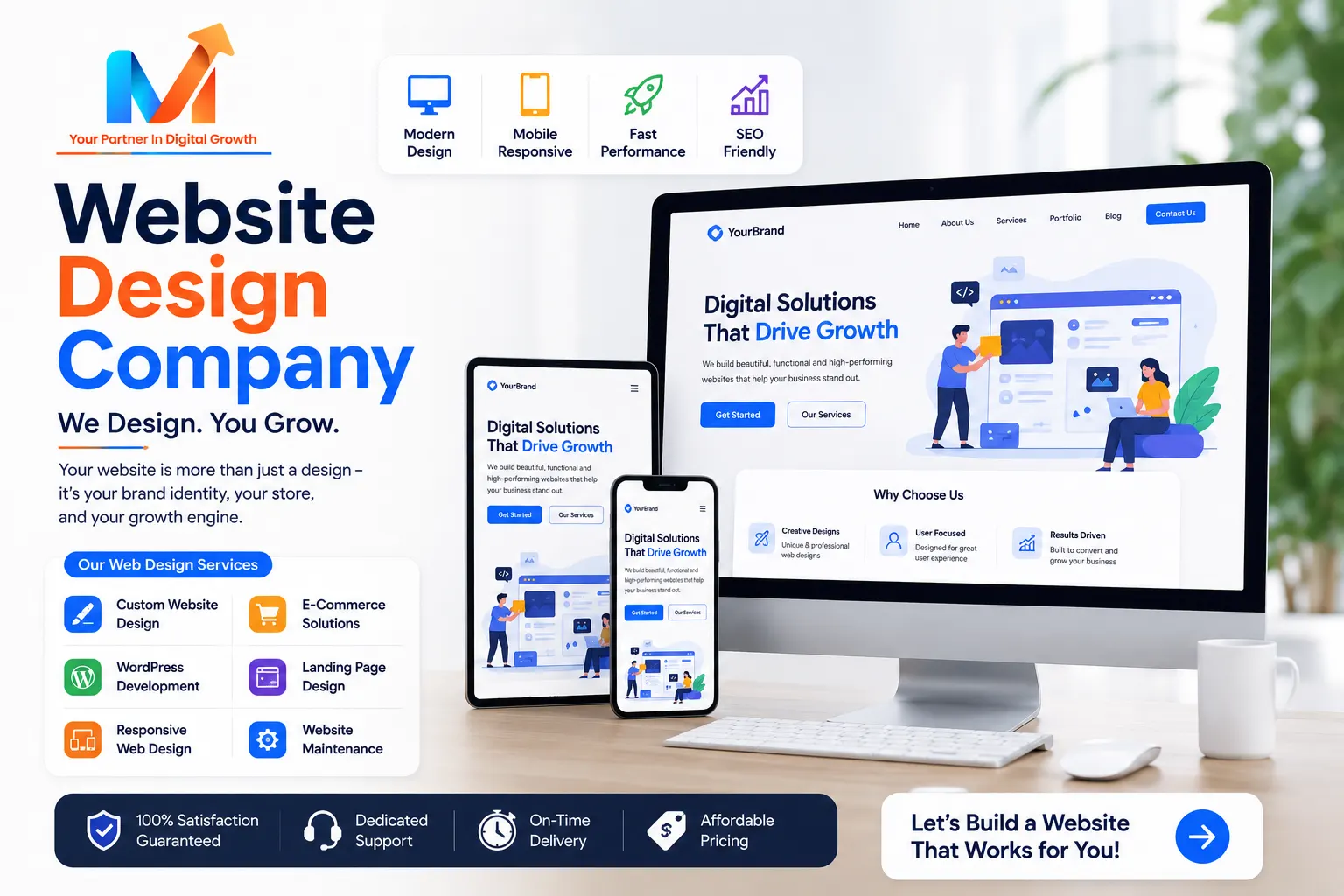
Choosing a website design company is a decision most business owners make once every four or five years, with very little information, under time pressure, and largely on the basis of whose portfolio looks nicest.
That's how people end up with a beautiful website that generates nothing — or worse, one they don't actually own. This guide is written to prevent both. It covers what a proper build includes, what it should cost in India, the ownership terms that matter, and the questions that separate a genuine partner from an order-taker.
First: what is a website actually for?
This sounds like a trivial question. It isn't, and getting it wrong is the root cause of most disappointing websites.
Your website is not a digital brochure or an online business card. It is a salesperson that works every hour of every day, and it should be judged the way you'd judge a salesperson: how many qualified enquiries did it produce this month?
Once you frame it that way, the criteria for choosing a design company change completely. "Does their work look good?" becomes secondary to "do they understand how a page turns a stranger into an enquiry?" Plenty of companies can make something look good. Far fewer can make it work.
What a full-service website design company should cover
A serious proposal covers considerably more than design and development. Look for all of these:
- Discovery and strategy. Your goals, your customers, your competitors, and what a lead is worth to you. If nobody asks about your margins, they're building blind.
- Information architecture. Which pages exist, how they connect, and what each one is supposed to achieve.
- Visual design. Custom or thoughtfully customised, consistent with your brand, and designed mobile-first rather than mobile-adapted.
- Development. Clean, standards-compliant, fast-loading code.
- Content. Either written for you or with clear guidance on what you must supply — settle this early, because it's the single biggest cause of delayed launches.
- On-page SEO. Title tags, meta descriptions, heading structure, schema markup, image optimisation, internal linking, and an XML sitemap.
- Analytics and conversion tracking. Without this you'll never know which pages earn their keep.
- Testing. Across browsers and real devices, plus Core Web Vitals and basic accessibility.
- Post-launch support. Updates, backups, security, and small changes.
If a quote is simply "website design and development" with a single number attached, you're buying a shell and hoping the rest is included.
What it costs in India
Prices vary enormously, which makes buyers suspicious — reasonably so. The variance is real, though, because "a website" covers wildly different projects. Realistic ranges for competent work:
- Brochure site (1–5 pages). Home, about, services, contact. The entry point for new or very small businesses.
- Business website (8–15 pages). Typically ₹60,000–₹2.5L. Service pages, blog, lead forms, proper on-page SEO. This is the most common project by a wide margin.
- eCommerce store. Usually ₹2.5L–₹12L+, depending on catalogue size, payment and shipping integrations, and how much is custom.
- Custom web application. Priced by scope — logins, dashboards, integrations, bespoke business logic.
What actually moves the number: the count of unique page designs, custom versus templated design, features like bookings or memberships or multi-language, and whether you or the company produces the content. Our detailed breakdown is in how much a website really costs.
Two warnings. Be sceptical of quotes dramatically below these ranges — at the bottom end nobody is doing discovery, custom design, or SEO; you're getting a template with your logo dropped in. And insist on an itemised, fixed-price proposal rather than a vague hourly estimate, so you can see what each component costs.
The ownership question — ask this before you pay anything
This is where businesses get quietly trapped, and it deserves more attention than it usually gets.
Confirm in writing that you will own, at minimum: the domain (registered in your company's name, not the agency's), the hosting account, the design files, and the full source code.
Some companies build on a proprietary platform you can never export from. Others register your domain under their own account "for convenience". Both feel harmless at the time. Both mean that leaving requires rebuilding your website from scratch and, in the worst cases, negotiating for your own domain name.
The test question is blunt and effective: "If I stop working with you next month, what exactly do I walk away with?" A good company answers "everything, and we'll help you migrate" without pausing.
Agency, freelancer, or in-house?
A freelancer is genuinely cost-effective for a small, straightforward site, provided you have the time to manage them and a clear brief. The risk is continuity — if they take on other work or become unavailable, your project stalls, and there's rarely anyone to escalate to.
A website design company earns its higher fee when you need design, development, copywriting, and SEO working as one system, and when you value the fact that work continues regardless of who is on leave. You're buying a team's range rather than one person's hours.
In-house only makes sense once you have continuous work to justify a salary — which for most businesses arrives long after the website is built.
Ten questions that reveal a good company
- "Can you show me a site you built and what it changed for that business?" Enquiries, conversion rate, revenue. Not "here's a pretty homepage."
- "What will you ask me before you start designing?" The best answer is a long list.
- "Who writes the content?" Settle this at proposal stage or your launch date will slip.
- "How fast are your recent builds?" Ask them to run one through PageSpeed Insights while you watch.
- "Is the design custom, or a purchased template?" Either can be legitimate — you just deserve to know which you're paying for.
- "How will conversions be tracked?" Listen for specifics: form submissions, calls, purchases.
- "How many revision rounds are included?" Vagueness here becomes friction later.
- "What happens after launch, and what does it cost?" Maintenance, backups, security, edits — in writing.
- "Will I own the domain, hosting, files, and code?" The answer must be an unqualified yes.
- "What would you advise me not to build?" The most revealing question on the list. A company willing to talk you out of spending understands your business rather than just your budget.
Red flags
- Guaranteed #1 Google rankings. Nobody controls Google's algorithm. This promise is always either dishonest or meaningless.
- No discovery phase. If they can quote a fixed price before understanding your business, they're selling a template.
- Portfolio without context. Screenshots prove someone can design. They prove nothing about results.
- Reluctance on ownership. Any hesitation here is your answer.
- No mention of speed, mobile, or SEO. These aren't extras; they're the difference between a website and an expense.
- Pressure to sign immediately. Discounts that expire tonight are a sales tactic, not a business reality.
The part most companies skip: conversion
Traffic is worthless if the page doesn't convert, and conversion is where most website projects quietly underperform. A few fundamentals worth insisting on:
A visitor should understand what you do and who you do it for within five seconds of landing. Every page should have one primary call to action, not three competing ones. Forms should ask for the minimum information you genuinely need — every extra field costs you submissions. The site must be fast, because each additional second of load time measurably reduces conversions. And it must be excellent on mobile, since that's where most of your traffic already is.
If you're also running paid ads, this matters twice over. Google's Quality Score factors in landing page experience, so a slow or irrelevant page raises your cost per click and lowers your conversion rate — you pay for the same mistake at both ends. A design company that has never heard of Quality Score is the wrong partner for a business that advertises. (See Google Ads for small business.)
WordPress or custom?
You'll be offered both, often with strong opinions attached. The short version: if your site is mostly content — service pages, a blog, forms, a portfolio — WordPress is almost certainly the right tool, and paying for a custom build would be waste. If it's mostly function — logins, dashboards, calculations, bookings, integrations — custom is usually cheaper in the long run than bending a CMS into an application.
We've covered the full trade-off in WordPress vs custom website. The honest summary: your visitors do not care what your site is built with. A well-built WordPress site beats a badly-built custom one every time. Judge the builder, not the technology.
How to make the decision
Shortlist three companies. Give each the identical brief and the identical budget. Then compare the written proposals rather than the sales conversations.
The strongest proposal will tell you what it will do, in what sequence, how success will be measured, what you're responsible for, and — crucially — what it will not do. Clarity about scope is the most reliable signal of competence you will get before any work begins.
Then speak to one of their current clients. Five minutes with someone who is actually paying them will tell you more than any case study, because you can ask the question that never appears in marketing material: "What has been frustrating?"
The bottom line
A good website is not an expense to be minimised. It is the one salesperson you employ who never sleeps, never takes leave, and speaks to every prospect who finds you. The objective isn't the cheapest quote — it's the best return on what you invest.
Choose the company that asks the most questions, explains its process clearly, hands you ownership of everything, and is willing to tell you when you don't need something. That combination is rarer than a good portfolio, and considerably more valuable.
Mind Your Ads is a website design and development company working with businesses across India and the USA. We build fast, mobile-first, SEO-ready sites designed to convert — and you own everything: domain, hosting, files, and code. Request an itemised, fixed-price proposal.
FAQ
What does a website design company do?
A full-service website design company handles discovery and strategy, information architecture, visual design, development, content and copywriting support, on-page SEO, analytics and conversion tracking, testing across browsers and devices, and post-launch maintenance. Design alone is only one part of the job.
How much does a website design company charge in India?
A brochure site of a few pages sits at the entry level. A typical 10-15 page business website runs roughly Rs 60,000-Rs 2.5L. eCommerce stores generally start around Rs 2.5L and rise with catalogue size and integrations. Custom web applications are priced by scope.
How do I choose the best website design company?
Shortlist three, give each the same brief and budget, and compare the written proposals rather than the portfolios. The right company asks more questions than it answers in the first meeting, tracks conversions, confirms you own everything, and can show what its work did for a client's business, not just how it looked.
Should I hire a website design company or a freelancer?
A freelancer is cost-effective for a small, simple site if you can manage them. An agency makes sense when you need design, development, copy, and SEO working together, plus continuity if one person becomes unavailable. Judge either on process and ownership terms, not price alone.
Will I own my website?
You should own the domain, the hosting account, the design files, and the full source code. Some companies build on proprietary platforms or keep hosting under their own account, which means you cannot leave without rebuilding. Confirm ownership in writing before making any payment.
How long does it take to build a website?
A straightforward business website usually takes 4 to 8 weeks from brief to launch. eCommerce and custom applications take longer. The most common cause of delay is content - copy and images arriving late from the client.