Laravel vs WordPress: Which Is Right for Your Website in 2026?
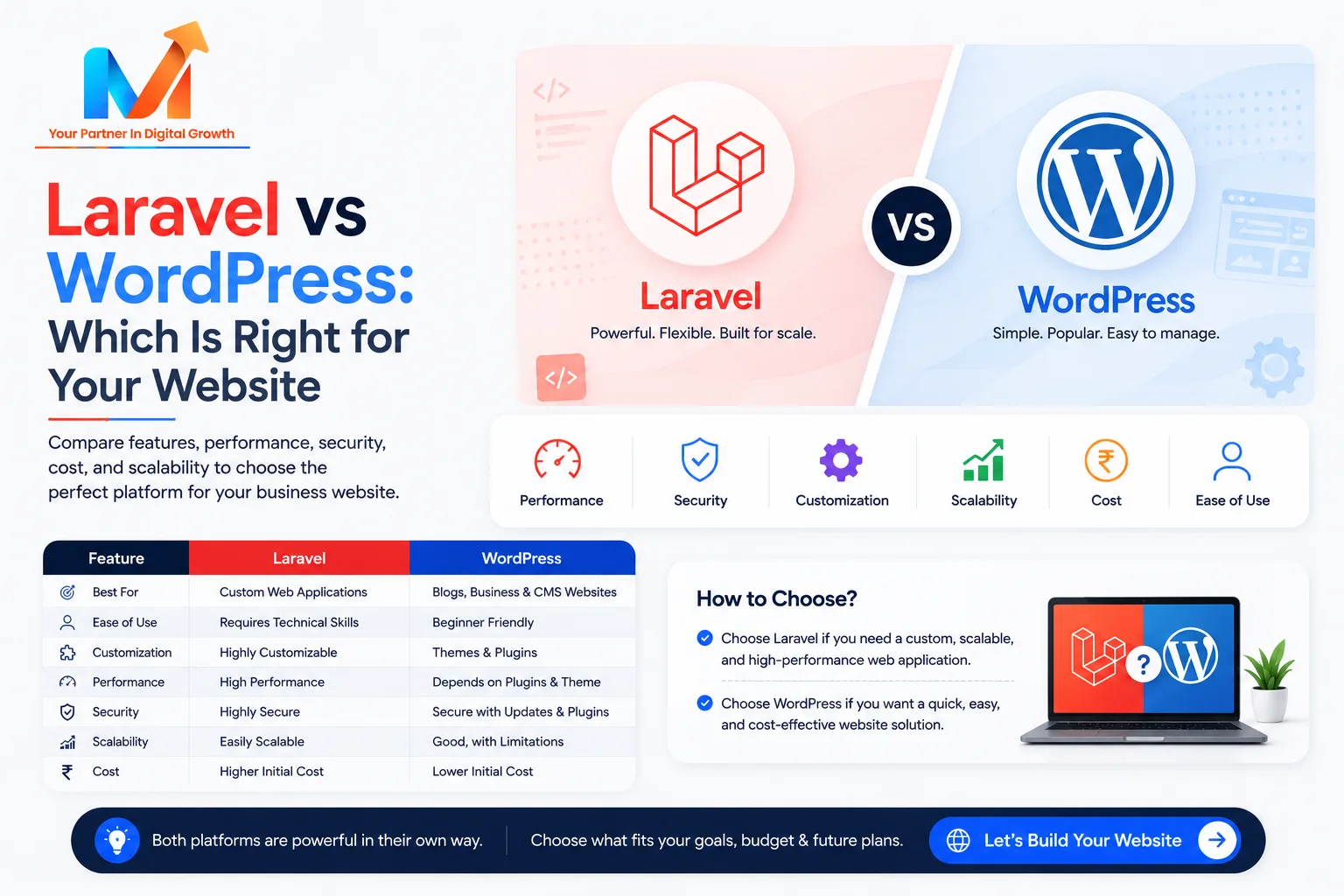
"Should we build it in WordPress or Laravel?" is one of the most common questions we get from businesses planning a new website or web app. Both are excellent — but they're built for different jobs. Here's how to choose.
What they are
WordPress is a content management system (CMS) — a ready-made platform for building websites and blogs, extended with themes and plugins. Laravel is a PHP framework — a foundation developers use to build fully custom web applications from scratch. One is a product; the other is a toolkit.
Laravel vs WordPress at a glance
| Factor | WordPress | Laravel |
|---|---|---|
| Best for | Blogs, brochure & content sites | Custom apps, portals, SaaS |
| Setup speed | Fast (ready-made) | Slower (custom build) |
| Flexibility | Limited by plugins/themes | Virtually unlimited |
| Security | Plugin-dependent, common target | Strong by design |
| Maintenance | Frequent plugin updates | Fewer moving parts |
| Upfront cost | Lower | Higher |
When WordPress wins
Choose WordPress for content-driven sites — company websites, blogs, and simple brochure sites — where you want non-technical staff to publish content quickly and budget is a priority. It's the fastest, most affordable route for a straightforward website.
When Laravel wins
Choose Laravel when you need custom functionality a CMS can't handle cleanly — customer portals, dashboards, booking systems, marketplaces, SaaS products, or heavy third-party integrations. Laravel gives you full control, stronger security, and a codebase built to scale. (This very site runs on Laravel.) See our website design & development and app development services.
The bottom line
It's not "which is better" — it's "which fits the job." Content site on a budget? WordPress. Custom, scalable web application? Laravel. Still unsure how the two compare on price? Read our guide to Laravel website cost in India, or talk to us and we'll recommend the right stack for your goals.
FAQ
Is Laravel better than WordPress?
Neither is universally better — they solve different problems. WordPress is ideal for content and brochure sites; Laravel is ideal for custom web applications that need flexibility, security, and scale. The right choice depends on what you are building.
Is Laravel more secure than WordPress?
Laravel has strong security built into the framework and fewer third-party plugins to exploit, so custom Laravel apps are generally more secure. WordPress can be very secure too, but its plugin ecosystem makes it a bigger target if not maintained.
Can I edit content myself on a Laravel site?
Yes — a Laravel site can include a custom admin panel (like this site does) so your team can manage content without touching code. It just has to be built in, whereas WordPress includes a content editor out of the box.