10 Google Ads Mistakes That Are Wasting Your Budget
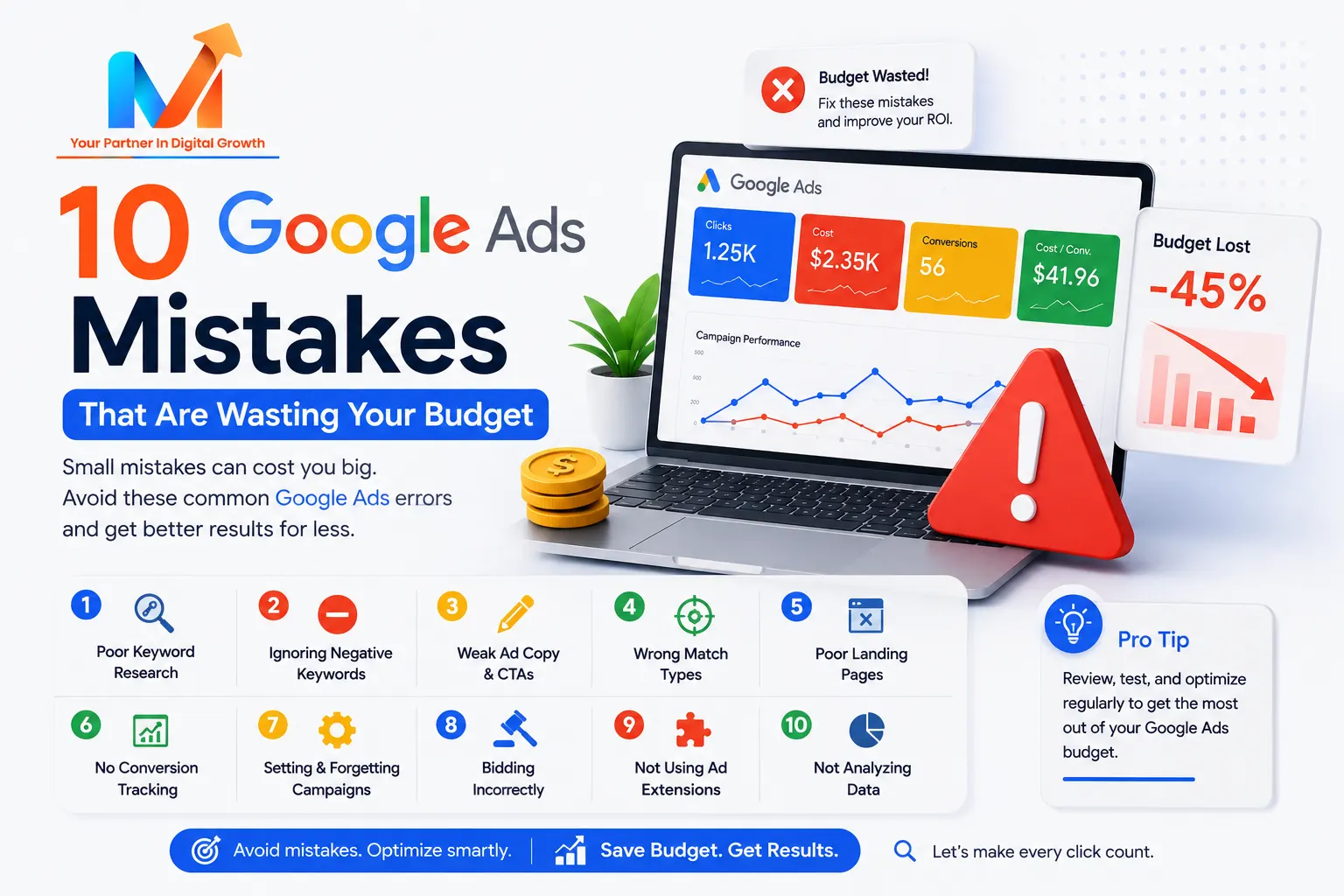
Google Ads can be one of the fastest ways to grow a business — or one of the fastest ways to burn cash. The difference usually comes down to a short list of avoidable errors. After auditing hundreds of accounts, we see the same google ads mistakes again and again. Here are the ten that quietly drain budgets, and how to fix each one.
1. No negative keywords
Without negative keywords, your ads show for irrelevant searches — "free," "jobs," "DIY," competitor names — and you pay for every wasted click. Fix: Review your search terms report weekly and add negatives aggressively. This one change alone often cuts wasted spend by 20–30%.
2. Sending all traffic to your homepage
Your homepage is a generalist. It rarely matches the specific promise of your ad. Fix: Send each ad to a focused landing page that continues the exact message and has one clear call to action.
3. No conversion tracking
If you can't see which clicks turn into leads or sales, you're optimising blind — and you'll never know your true return. Fix: Set up conversion tracking with GA4 and Google Tag Manager before you spend a rupee. This is non-negotiable.
4. Using only broad match keywords
Broad match casts a wide net and, without guardrails, catches a lot of junk. Fix: Combine tighter match types with a strong negative keyword list, and let the data tell you what to expand.
5. Ignoring Quality Score
Google rewards relevant ads with lower costs and better positions. A low Quality Score means you're overpaying for every click. Fix: Tighten the match between keyword, ad copy, and landing page. Relevance is the lever.
6. "Set and forget"
Google Ads is not a slow cooker. Accounts left alone drift — costs creep up, winning ads fatigue, and competitors adjust. Fix: Review and optimise at least weekly: bids, search terms, ad performance, and budget pacing.
7. Weak ad copy
Generic ads ("Best Services — Contact Us") get ignored. Fix: Lead with a specific benefit, include a number or proof point, and end with a clear action. Then A/B test relentlessly.
8. No remarketing
Most visitors don't convert on the first visit. If you're not following up, you're leaving warm leads on the table. Fix: Run remarketing campaigns to re-engage past visitors — they convert at a far higher rate and lower cost.
9. Bidding on the wrong goal
Optimising for clicks when you want leads gets you… lots of clicks. Fix: Choose a bid strategy tied to your real business goal — conversions or conversion value, not traffic.
10. Not tracking phone calls
For many service businesses, the phone is the main conversion — and it's often invisible in reporting. Fix: Add call tracking so calls count as conversions and inform your bidding.
The pattern behind all ten
Notice the theme: nearly every mistake is a failure of measurement or relevance. Track what matters, keep ad-to-landing-page relevance tight, and review often. Do that, and you'll spend less to get more — which is the whole point.
Not sure which of these are hurting your account? Request a free Google Ads audit — we'll show you exactly where the budget is leaking.
FAQ
What is the most common Google Ads mistake?
Running without conversion tracking. If you can't measure which clicks become leads or sales, every other decision is a guess - and you can't tell whether the account is actually profitable.
How often should I optimise my Google Ads account?
At least weekly. Review search terms, add negative keywords, check ad and bid performance, and monitor budget pacing. Accounts left alone tend to drift and waste money.
Do negative keywords really make a difference?
Yes - often a big one. A strong negative keyword list stops your ads showing for irrelevant searches, which can cut wasted spend by 20-30% and improve your Quality Score.
Is remarketing worth it for small businesses?
Absolutely. Most visitors don't buy on their first visit. Remarketing re-engages them at a lower cost per conversion, making it one of the highest-ROI campaign types for small budgets.