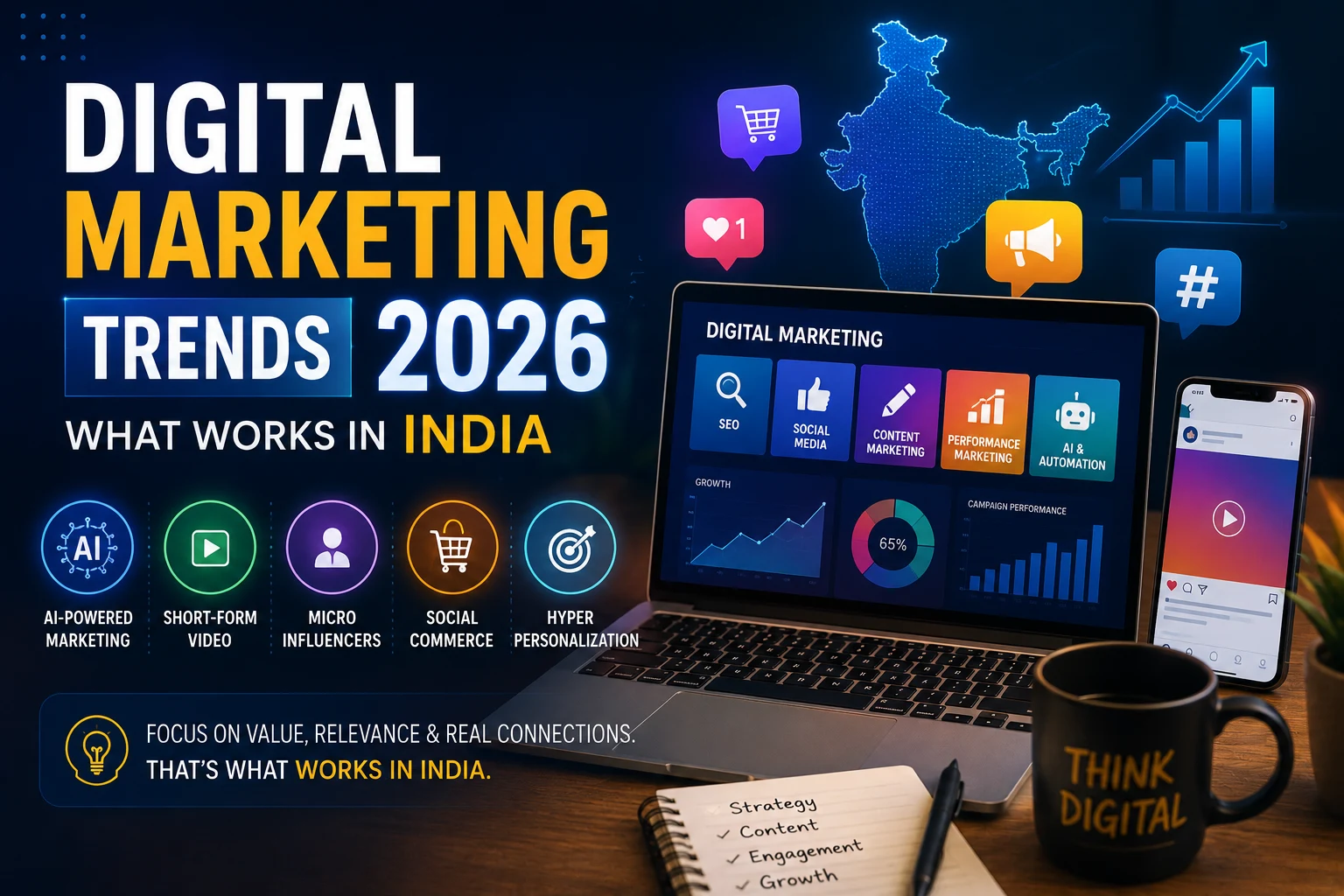
Digital Marketing Trends 2026: What Actually Works in India & USA
Updated May 2026 · By the Mind Your Ads Strategy Team · 12 min read
If you ran the same digital marketing playbook in 2026 that worked in 2024, you'd have already lost. The numbers prove it. India's digital ad spend is projected to cross ₹69,856 crore by the end of 2026, growing 19% year-on-year, and yet most agencies are still selling tactics that were retired by Google twelve months ago.
This guide is different. We've spent the last 18 months managing over ₹50 crore in ad spend across 500+ clients in India and the USA, and we've watched first-hand what's actually moving the needle in 2026 — and what's quietly bleeding marketing budgets dry.
Here are the 11 digital marketing trends that are defining 2026, with the real data, the tactics that work, and the tactics to retire today.
⚡ TL;DR — The 11 Trends in 60 Seconds
- AI Overviews now answer 80%+ of searches — ranking #1 isn't enough anymore.
- Generative Engine Optimization (GEO) replaces traditional SEO as the new discoverability layer.
- E-E-A-T is the #1 ranking factor — author credentials beat content volume.
- Topic clusters > isolated blog posts; topical authority is now mandatory.
- Branded search volume is the strongest predictor of ranking growth in 2026.
- Performance Max + Advantage+ now consume 60%+ of paid budgets — but only with strong creative.
- Connected TV (CTV) advertising in India is set to hit ₹3,500 crore by 2027.
- Micro-influencer marketing outperforms celebrity campaigns for D2C brands.
- Zero-click searches passed 69% — visibility metrics replace traffic metrics.
- First-party data + server-side tracking is no longer optional after cookie deprecation.
- Video-first content (YouTube Shorts, Reels) embedded in blog posts boosts SEO rankings.
1. AI Overviews Have Changed the Rules of Search Forever
In May 2024, Google rolled out AI Overviews. By early 2026, those AI summaries appear on the majority of informational searches and serve over 2 billion monthly users. The result: zero-click searches have surged from 56% to roughly 69%.
Translation — even when you rank #1, the user often gets their answer directly from the AI summary and never visits your site.
What's working in 2026:
- Writing in clear, declarative "definition" sentences early in the article (AI engines lift these for citations).
- Adding a TL;DR summary box near the top of every post — this dramatically increases the chance of being cited.
- Using FAQ schema with concise, direct answers to the long-tail questions users actually ask.
- Tracking AI Overview visibility with tools like Profound, Otterly.ai, and Bluefish AI alongside traditional rank tracking.
What to retire:
Burying the answer 800 words deep so users "have to read the whole post." That tactic was built for 2018 SEO. Today, if you don't surface the answer in the first 100 words, AI Overviews will pull from a competitor who did.
2. Generative Engine Optimization (GEO) Is the New SEO
ChatGPT now holds roughly 17% of all digital search volume. Add Perplexity, Google Gemini, and Claude, and traditional search engines no longer have a monopoly on "how do I find an answer." Gartner predicts that by 2028, 90% of B2B buying journeys will be intermediated by AI agents.
GEO is the practice of optimizing your content so that AI engines cite, reference, and recommend your brand inside their generated answers. It's adjacent to SEO, but the rules are different.
How to get cited by AI engines:
- Use structured data (schema.org) aggressively — Article, Organization, FAQ, HowTo, Product. AI engines parse schema before prose.
- Establish strong entity associations: mention your brand near your category keywords consistently across the web.
- Get cited on Wikipedia, industry publications, and authoritative directories — these are training-data inputs.
- Build a Knowledge Graph presence: claim Google Knowledge Panel, link your sameAs identifiers (LinkedIn, Crunchbase, etc.).
- Publish unique, citable data — original research, surveys, benchmarks. AI engines disproportionately quote these.
3. E-E-A-T Is Now the Single Most Important Ranking Signal
Google's E-E-A-T framework — Experience, Expertise, Authoritativeness, Trustworthiness — went from "a guideline" to "the dominant ranking factor" over the last 18 months. The reason is simple: AI can now generate infinite mediocre content, so Google has to weight signals it can't easily fake.
This is great news for real businesses with real expertise. It's terrible news for content farms.
What proves E-E-A-T in 2026:
- Real author bios with real photos, LinkedIn profiles, and verifiable credentials (Google Partner, Meta Business Partner, etc.).
- First-person language: "In a recent campaign for a D2C client, we reduced CPL by 47% by…" — this signals genuine experience.
- Screenshots of real dashboards, ad accounts, Search Console data — proof you've done the work.
- Case studies with specific numbers, client names (with permission), and timelines.
- Mentions, reviews, and citations on third-party sites — Clutch, GoodFirms, Trustpilot, Google Business Profile.
💡 Mind Your Ads Insight: When we audit underperforming agency blogs, the #1 issue we find isn't poor writing or bad keywords — it's missing E-E-A-T signals. Anonymous "Admin" author bylines, no credentials displayed, no case studies. Google reads that as "could be AI, could be human, no way to tell" and ranks it accordingly.
4. Topic Clusters Have Killed the Standalone Blog Post
In 2026, Google evaluates your site's topical authority — how comprehensively you cover a subject — far more than the optimization of any single page. A 2,000-word blog post sitting on a site with 8 unrelated articles will lose to a 1,200-word post on a site with 30 deeply interconnected articles in the same niche.
How to build topic clusters:
- Pick 3–5 core service areas (for us, that's PPC, SEO, social media, web design, app development).
- Build a comprehensive pillar page for each — 2,500+ words covering the topic exhaustively.
- Surround each pillar with 8–12 supporting articles answering specific sub-questions.
- Interlink everything: pillars link down to supports, supports link up to pillars, supports link sideways to each other.
- Update the cluster every 90 days — fresh dates and new sections trigger re-crawls and ranking lifts.
5. Branded Search Volume Is the New Domain Authority
Here's a counter-intuitive 2026 finding: when a brand's branded search volume (people Googling your brand name) starts climbing, every other keyword the site ranks for tends to climb with it. Search engines treat branded demand as the strongest possible trust signal.
This is why we're seeing agencies invest heavily in podcast appearances, founder LinkedIn content, paid social to build awareness, and creator partnerships — even when the direct ROI is unclear. The indirect SEO lift is enormous.
How to grow branded search:
- Get the founder on 5–10 industry podcasts per quarter.
- Run brand-awareness campaigns on YouTube, Meta, and LinkedIn — measure the lift in branded search via Search Console.
- Partner with mid-tier creators in your niche for sponsored content that drives recall.
- Be relentlessly consistent on LinkedIn and Twitter/X — frequency builds memory, memory drives branded queries.
6. AI-Powered Ad Platforms Now Consume Most of Paid Spend — But Creative Is the Bottleneck
Performance Max (Google), Advantage+ (Meta), and AI-optimized LinkedIn campaigns now handle the majority of bidding, audience expansion, placement, and creative combination automatically. For most accounts we manage, these AI-driven campaign types now consume 60–80% of paid budgets.
The catch — AI optimizes ruthlessly within the inputs you give it. Feed it five mediocre creatives and a vague audience, and it will efficiently waste your money. Feed it 30 strong creative variants and clean conversion data, and it will outperform any manual campaign.
The new paid media playbook:
- Brief teams now produce 20–40 creative variants per campaign, not 3–5. Volume of creative is the new lever.
- First-party data integration (Customer Match, Enhanced Conversions) is mandatory — without it, AI bidding is flying blind.
- Server-side tracking (GTM Server, CAPI) replaces client-side pixels as third-party cookies fully deprecate.
- Manual search campaigns still win for high-intent branded and competitor terms — don't fully delegate to PMax.
- Creative testing cadence: refresh top variants weekly, kill underperformers within 5–7 days.
For a deeper breakdown of what's working in Google Ads management right now, see our PPC playbook.
7. Connected TV (CTV) Is the Sleeping Giant of Indian Digital Marketing
India had over 50 million active CTV households at the start of 2025, projected to roughly double within four years. CTV ad spend in India jumped from ₹450 crore in 2022 to ₹1,500 crore in 2024, and is forecast to hit ₹3,500 crore by 2027 — annual growth of 40–47%.
If your business sells anything to upper-middle-class urban Indian consumers (D2C, fintech, edtech, real estate, automotive), CTV is the channel where attention is moving and competition is still light.
How to use CTV in 2026:
- Run YouTube CTV campaigns (the largest CTV inventory pool in India) with skippable and non-skippable formats.
- Test JioHotstar, ZEE5, Sony LIV, and Amazon miniTV inventory — programmatic CTV is now buyable through DV360 and The Trade Desk.
- Repurpose your best Meta video ads — most work on CTV with minor 16:9 reformatting.
- Set up incremental lift studies — CTV's measurement is harder than search, so measure brand and search lift, not last-click conversions.
8. Micro-Influencers Are Outperforming Celebrities for Indian D2C Brands
Trust in conventional celebrity advertising is declining across Indian markets, especially among Gen Z and millennial buyers. Brands are pivoting to creators with 10K–500K followers in tightly defined niches — the engagement rates and conversion rates are consistently 3–5x higher.
What's working:
- Building always-on creator networks of 20–50 micro-influencers, not one-off celebrity deals.
- Performance-based partnerships: flat fee + per-conversion commission via tracked links.
- UGC (user-generated content) repurposed into paid ads — these often outperform branded creative by 2x on Meta.
- Live commerce on Instagram and YouTube — Indian D2C brands are running creator-led live shopping with strong conversion rates.
9. Vanity Metrics Are Out — Visibility Metrics Are In
With 69% of searches now ending in zero clicks and 80%+ of B2B buying journeys involving AI agents, traditional KPIs like sessions, pageviews, and click-through rates are increasingly misleading. The brands winning in 2026 measure differently.
The 2026 KPI stack:
- Branded search volume (Google Search Console) — leading indicator of brand strength.
- AI Overview & ChatGPT citation share — how often your brand appears in AI-generated answers.
- Impression share on target keywords — visibility, even when clicks are flat.
- Assisted conversions and view-through conversions — the full attribution path, not last click.
- Customer acquisition cost (CAC) and customer lifetime value (CLV) — the only numbers that matter at the business level.
10. First-Party Data Is the New Marketing Moat
Third-party cookies are now effectively gone in Chrome. iOS privacy restrictions continue to tighten. Without first-party data infrastructure, your retargeting, lookalike audiences, and attribution are operating on degraded signal.
The first-party data essentials:
- CRM integration with ad platforms via Customer Match (Google) and Custom Audiences (Meta).
- Enhanced Conversions (Google) and Conversions API (Meta) deployed server-side.
- Email list growth as a strategic priority — every lead magnet, content download, and webinar feeds the list.
- Consent management platform (CMP) compliance for Indian DPDP Act and US state privacy laws.
- Server-side Google Tag Manager — replaces client-side tracking and dramatically improves data quality.
11. Video Is Now Mandatory — Even for SEO
Here's a finding that surprised even our team. We took ten of our top-ranking blog posts, produced short YouTube videos covering the same content, embedded each video into its corresponding post, and watched what happened over 90 days.
Average ranking improvement: +1.8 positions. Two posts that were stuck at #4–6 climbed to #1. Average dwell time on the posts increased by 47%. The ranking lift was real and consistent.
In 2026, video is no longer just a content format — it's an SEO ranking input. Pages with relevant embedded video signal richer engagement and earn higher rankings, especially for informational queries.
The video-SEO playbook:
- Turn every long-form blog post into a 3–6 minute YouTube video covering the same content.
- Optimize the YouTube video for search (title, description, tags, transcript) — it ranks separately on Google.
- Embed the video near the top of the corresponding blog post.
- Repurpose the video into 60-second YouTube Shorts and Instagram Reels for distribution.
- Add VideoObject schema to the blog post so search engines link page and video.
Quick Snapshot: India vs USA — Where the Markets Differ in 2026
| Dimension India USA | ||
| Mobile share of digital ad spend | ~78% (mobile-first market) | ~65% (desktop still relevant) |
| Dominant social platform | Instagram + WhatsApp | Instagram + TikTok + LinkedIn |
| Vernacular content priority | Critical (Hindi, Tamil, Marathi, etc.) | Low (English-dominant) |
| CTV maturity | High growth (40%+ YoY) | Mature, programmatic |
| Avg. Google Ads CPC (B2B) | ₹40–250 | $3–25 |
| Privacy regulation | DPDP Act 2023 | State-by-state (CCPA, etc.) |
| WhatsApp Business adoption | Mainstream sales channel | Niche / minimal |
The Bottom Line: Where to Focus in 2026
If you only have bandwidth to act on three of these eleven trends, here's what we'd choose for almost any business — based on what consistently delivers ROI for our clients:
- Build genuine E-E-A-T. Real authors, real credentials, real case studies. This single change unlocks every other ranking and AI-citation gain.
- Restructure content into topic clusters. Stop publishing standalone posts. Build pillars and supporting articles that interlink. Topical authority compounds.
- Invest in first-party data infrastructure. Server-side tracking, CRM integration, email list growth. Without this, AI-driven ad platforms can't perform.
Everything else — CTV, micro-influencers, GEO, video integration — is high-value, but those three are the foundation. Without them, the rest is built on sand.
🎯 Free 30-Minute Strategy Call
Want to know which of these 11 trends matter most for your specific business — and how to deploy them without wasting budget?
Book a free strategy call with the Mind Your Ads team. We'll review your current marketing, identify the 2–3 highest-leverage moves for the next 90 days, and tell you exactly what to do — whether you hire us or not.
📞 India: +91 965-065-0212 | 📞 USA: +1-716-254-3097
✍️ About Mind Your Ads
Mind Your Ads is a certified Google Partner, Meta Business Partner, and Bing Partner agency with 8+ years of experience and 500+ clients across India and the USA. We've managed over ₹50 crore in ad spend and currently work with businesses across 20+ industries — from D2C brands and fintech to law firms, real estate, and SaaS companies.
Our certifications: Google Ads, Google Analytics, Meta Blueprint, Microsoft Advertising, Amazon Ads, Shopify Partner, AWS Partner.
Average client results: 340% ROI, 65% lower cost per lead, 95% client retention rate.